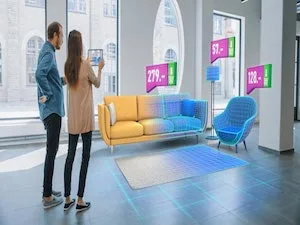
Augmented reality (AR) brings shoppers back into shops by giving them something a website can't: an experience. It gets a brand talked about, draws a crowd in store, takes the worry out of buying, shows the whole range in a small shop, puts product details on the spot and can lead people to the door.
Why do shops need a new reason to visit?
In the years up to 2022, countless shops closed and major retailers went bust. Fewer people came through their doors, because of more competition, the rise of online shopping and changing customer expectations, and lockdowns made all three worse.
Customers now expect a satisfying experience whether they shop online or in store. To bring them in, a shop has to offer an experience they can't get from browsing a website, and above all entertain them. AR, growing fast in retail, is a way to do that.
How does AR get a brand noticed?
More people through the door starts with more people seeing the brand, and press coverage helps. Several AR campaigns have taken off on social media and been picked up by the news:
- The Airwalk Invisible Pop Up Store was worth $5 million in earned media, thanks to features in Mashable, Business Insider, TechCrunch and several other major publications.
- Pepsi, not a retailer, promoted Pepsi Max with an AR ad in a London bus shelter that surprised and entertained commuters. By 2022 its YouTube video alone had more than 8 million views, and Forbes and The Verge had covered it.
Advertising is everywhere. AR helps a campaign cut through it, and gets people curious, talking on social media and writing about it.
Why does an in-store experience draw a crowd?
If a product is easy to find online, a shop has to offer something more: an experience customers can't have online. The shop of the future has to be more than a place to buy things.
The experience can be fun, practical or both, but above all it has to give people something of value.

How does AR take the worry out of buying?
Used to solve a problem, AR removes stress, anxiety and effort from shopping. AR mirrors in a dressing room and Sephora's app, which lets customers try on make-up virtually, have the same aim: removing what stops people buying.
Because it solves a problem, it becomes a tool customers rely on, to ease their doubts about a purchase and make up their minds.
How can a small shop show every product?
Space is one of a shop's biggest limits: it can hold only so much stock, while the choice online is almost endless. With AR, customers can see products a smaller shop doesn't stock, so every shop can show the full range, cost-effectively.
A wider range is one of the main reasons people shop online. Knowing they can see all of it in store, they have fewer reservations about coming in. How 4 Roads showed Hitachi Vantara's hardware racks without shipping them.
What can shoppers see when they scan a product?
Everything they need to decide, in front of them: product and pricing information, care tips, colour and style options and, most important, customer reviews. That matters most where buying makes people anxious, as with larger purchases.
'Exploded views' let customers look into the parts that interest them. An exploded view of an iPhone battery, for example, could give its technical specification, or show its size against other models and brands.

Shoppers already use their phones in store: 58% of consumers use their smartphones inside shops to research the products in front of them. With AR, they do that research with you, not on another site where you risk losing the sale.
Can AR lead people to a shop?
It already has, in AR marketing campaigns, most famously for Burger King. People held their phones up to McDonald's ads, which burned away and became a Burger King ad, with a free Whopper and directions to the nearest Burger King.
Burger King turned its main rival's huge advertising spend into ads of its own, and brought more people into its nearby restaurants. The trick was to make it entertaining, or in this case controversial. How 4 Roads guided travellers through Newcastle Station with the technology behind AR.
What happens to a shop that doesn't change?
It goes backwards. Other brands are trying new technology, and customers use it more every day, so standing still means falling behind. Even Toys 'R' Us, once the dominant retailer in a multi-billion-dollar category, went bust.
Where should a retailer start?
With the customer. AR has been in retail longer than many people think, and brands of every size are trying it. It is no longer a buzzword: used with a plan, it brings more people into a shop and engages them once they are there. Whatever you build, it has to give customers something of value. How 4 Roads builds augmented reality.
Updated on 19 September 2026.