I just read a post on the subject of large language models focusing on the idea that they “hallucinate”, “gaslight”, or confidently make things up. While the behaviour is real, the framing is often wrong.
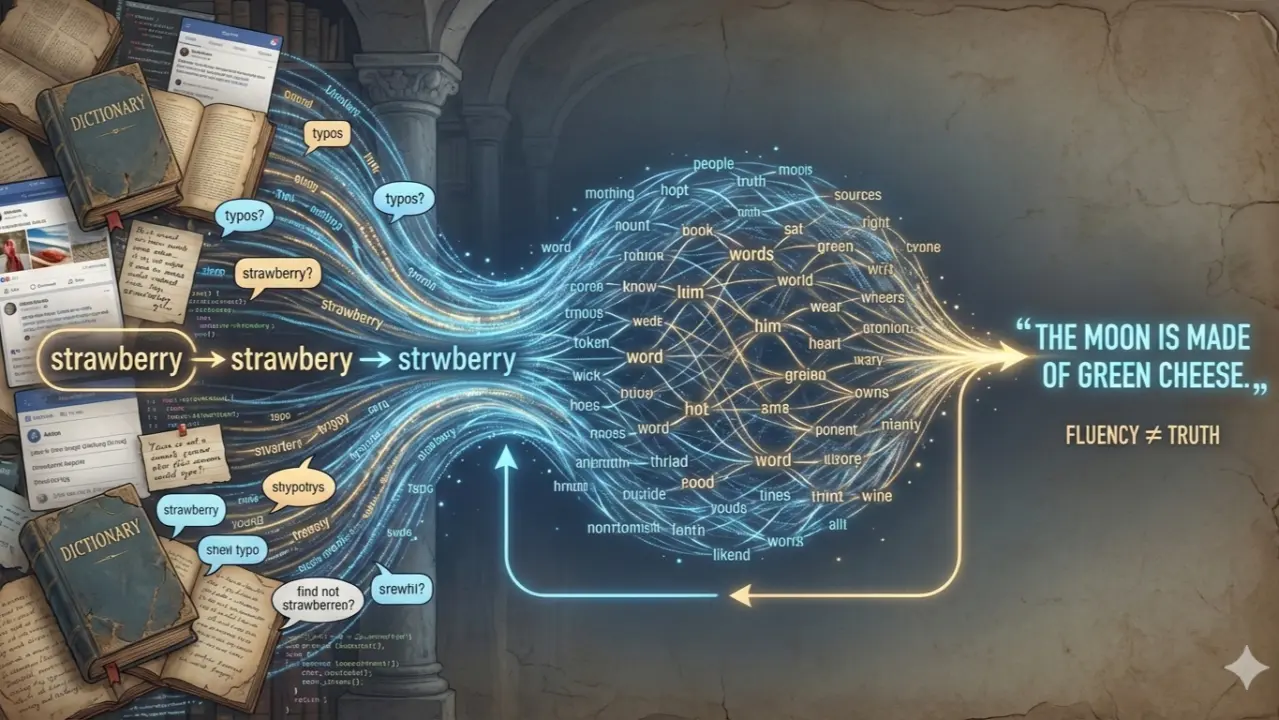
LLMs like ChatGPT aren’t lying, being deceptive, or pretending to understand anything. They don’t know facts. They don’t reason with intent. They don’t hold beliefs. What they do is generate language that is statistically likely to follow from what came before, based on patterns learned from vast amounts of human text.
When an LLM produces something that sounds authoritative but turns out to be incorrect, that isn’t deception, it’s a side-effect of optimising for linguistic plausibility rather than factual certainty.
In other words, it’s not gaslighting. It’s pattern completion.
This becomes especially interesting when people point out spelling mistakes or inconsistencies and treat them as proof that AI is “getting worse” or “doesn’t understand basics”. But spelling, like meaning, is not a rule-based system inside an LLM. These models don’t work with letters; they work with tokens, learned from global usage.
Which leads to a deeper question: what actually counts as “correct” spelling?
Dictionaries like the Oxford English Dictionary are normative. They codify language carefully, conservatively, and with intent. They apply human judgment, historical context, and etymology. They deliberately lag behind usage to provide stability.
LLMs, by contrast, are descriptive. They absorb how the world actually writes across regions, dialects, cultures, internet slang, professional jargon, typos, evolution, and change. What they encode looks less like a dictionary and more like a probabilistic map of global language use.
From that perspective, a frequently repeated “misspelling” isn’t necessarily wrong; it may simply be a word in transition.
That’s not a new idea. English itself is largely built on what were once mistakes:
“Ye olde” is a printing artefact.
American spellings like color were deliberate simplifications.
Silent letters and inconsistent vowels are often fossilised errors or accidents of history.
Language evolves through repetition, not authority.
Where AI complicates things is speed and scale. It observes frequency without intention, and its outputs are then copied by millions of people. That creates feedback loops which can accelerate linguistic change faster than any dictionary committee ever could.
This is where my own experience matters. I’m dyslexic, and for most of my life spelling has been treated as a proxy for intelligence, care, or credibility despite having little to do with any of those things. Dyslexia exposes something uncomfortable: spelling is not intuitive, logical, or phonetic. It’s historical baggage.
Take strawberry.
Phonetically, strawbery is more accurate. It reflects how the word is actually spoken by most people. "The extra “r” survives not because it adds clarity to the modern ear, but because it’s inherited an etymological fossil that our pronunciation has long since outgrown.".
If enough people consistently wrote strawbery, no linguist would be shocked. That’s exactly how English has always evolved.
What LLMs do, beneath their layers of human fine-tuning, is surface these pressures. While developers try to impose rules, the core models don’t privilege etymology or tradition; they privilege frequency.
This is where AI may quietly reshape language.
Not by inventing new words, but by normalising the spellings people already use. By flattening regional variants. By reinforcing phonetic simplicity. And by weakening the authority of institutions whose role has historically been to slow change, not stop it.
Dictionaries won’t suddenly become “wrong”. But they may become less central. Language has always been negotiated socially; AI just speeds up the negotiation and removes some of the gatekeeping.
The real takeaway isn’t that LLMs hallucinate, gaslight, or misunderstand language.
It’s that they reveal something we prefer not to confront:
fluency is not truth
spelling is not intelligence
and “correct” language has always been provisional
AI isn’t breaking language. It’s showing us how it actually works and how it might change next.
First published on LinkedIn on 15 January 2026.