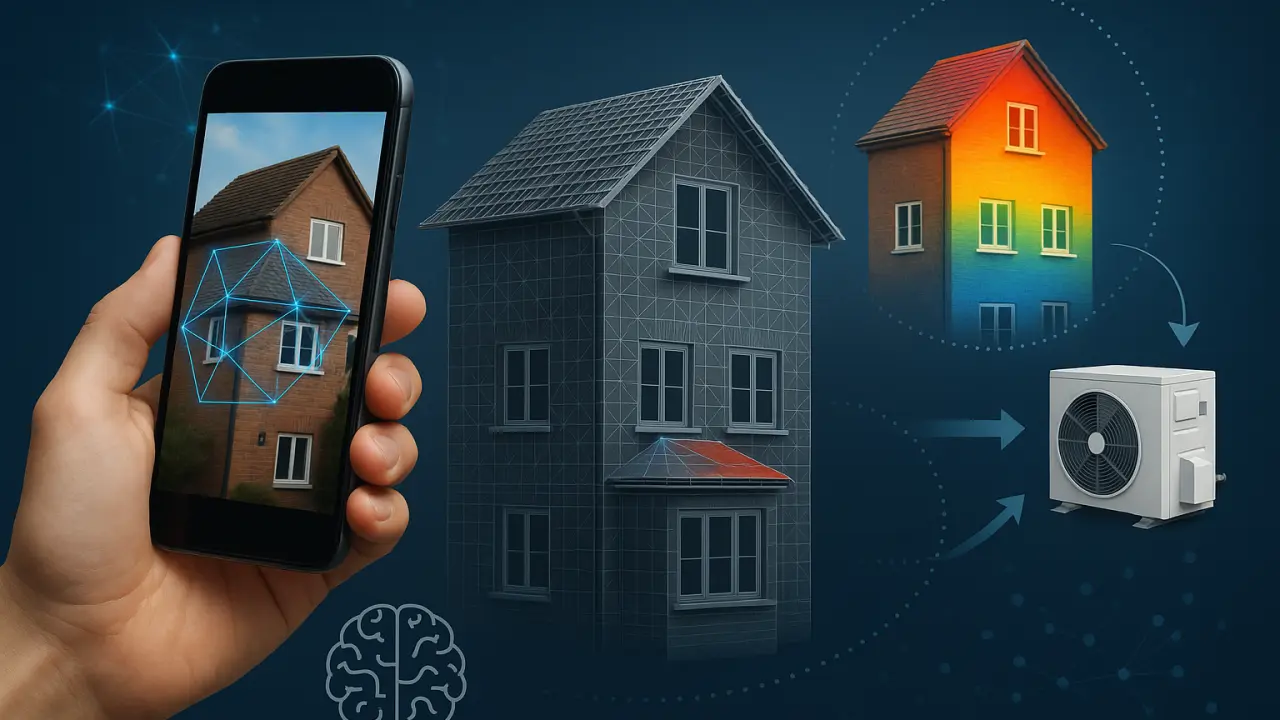
Over the past few years, we've had the opportunity to work on some truly cutting-edge technology, building a digital twin of a house using just a standard smartphone. Our mission was ambitious: scan and reconstruct a 3D model of a home, calculate its heat loss, and then guide installers through the retrofit or heat pump installation process.
This work was backed by BEIS (now DESNZ), and brought together a crack team of PhD-level researchers working on frontier technologies like SLAM, COLMAP, NeRF, COCO, and others. We tackled the challenge of identifying objects, capturing measurements in 3D space, and stitching it all together into an accurate, whole-house model. It was deep tech. And yes that IP and work is now patented by the company we were working with, based directly on our R&D.
We learned a huge amount. And we’re absolutely keen to re-apply these skills in future projects, in any industry, so if you're working in Vision AI, AR, or spatial computing or the renewables industry, and need support in your blue-sky research, let’s talk.
The Surprising Realization: Too Accurate Can Be Inaccurate
Here’s the interesting part.
While the primary goal was to create a highly accurate digital twin to calculate heat loss, our team, being outsiders to the energy and retrofit industry brought a fresh perspective. And with some time to reflect, I’ve come to a somewhat provocative conclusion:
Creating a digital twin for this purpose is too accurate and in being so, becomes inaccurate.
How?
Because UK housing stock is a mess (no offense, UK builders). Homes were often built with poor standards, have been modified or extended over the years, and generally lack consistency. You’re working with historical quirks, undocumented changes, and unpredictable behaviours. And then you add external variables like:
How people live in their homes
Air change frequency and its variability
The period used to define degree days
The agreed System Design Temperature
Inaccurate or unavailable construction documentation, slumped/missing insulation, non standard construction..... the list goes on.
In the end, trying to achieve engineering level precision in these conditions is misguided. It’s expensive, time consuming, and ultimately doesn’t deliver actionable insight.
What Actually Matters
We created exact models, but for the needed outcomes we only needed:
To get accurate enough to match the home’s heat loss window with the operating window of a heat pump.
That’s all.
If you can do that, you can confidently size and specify a heat pump that works without obsessing over photorealistic geometry or millimetre measurements. And this problem is getting easier with better modulating heat pumps and clever flow control using dynamic water pumps.
What’s Next?
I’ve been mulling over how this can be solved better, faster, and more affordably using AI and big data. There’s a vision forming, a new perspective, that applies knowledge learned but shifts the focus toward pragmatism over perfection. Delivering what consumers need as well as supporting the installer network with straightforward tools.
TL;DR
We built an agnostic smartphone-based 3D scanning system to model homes and calculate heat loss.
We used bleeding-edge Vision AI tech and helped generate patents for a commercial partner.
In hindsight, a digital twin is overkill for this use case, real world functional accuracy matters more than engineering accuracy and the need for complex user training.
Exploring how AI can solve this differently
I am not a heating engineer, designer or installer, (although I have been surrounded by them for the last three years) so this really is an opinion piece, if you are in the industry let me know what you think, have I missed the mark?
How 4 Roads builds apps and augmented reality.
First published on LinkedIn on 24 September 2025.